
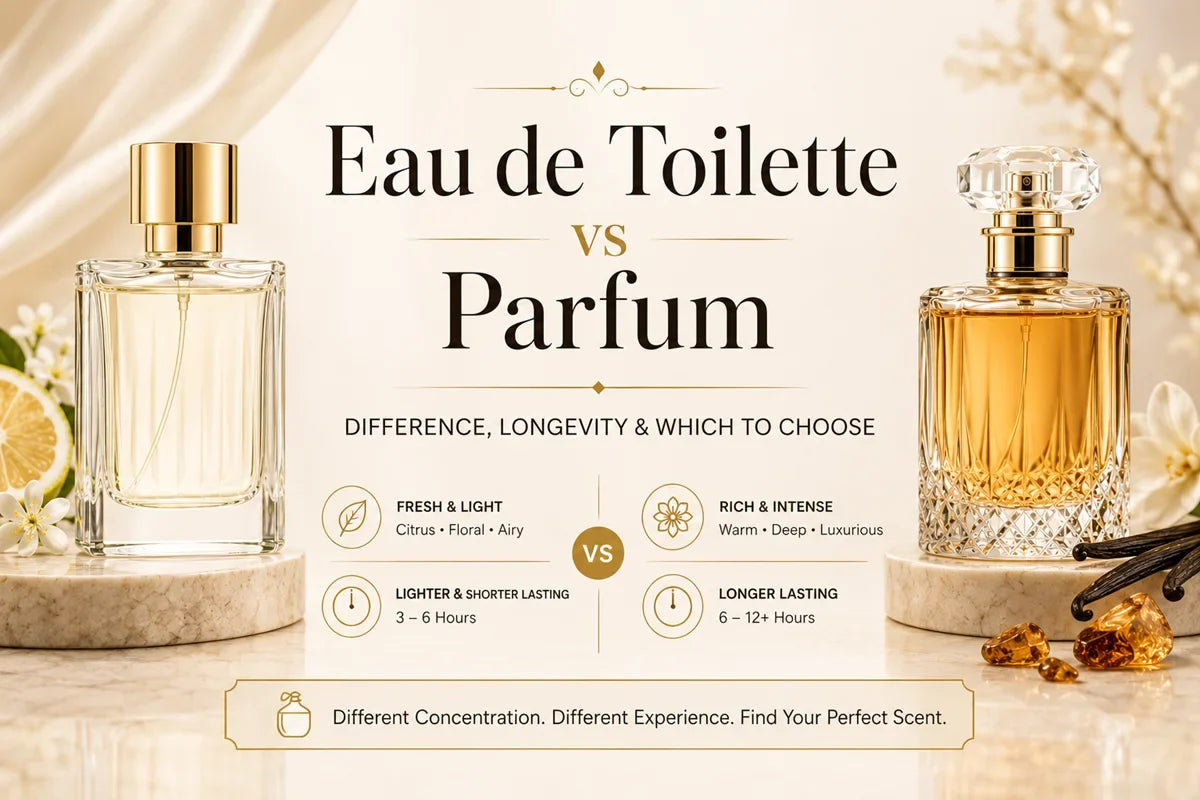
If you've ever looked at a fragrance bottle and wondered what EDT, EDP or Parfum actually means, you're not alone.
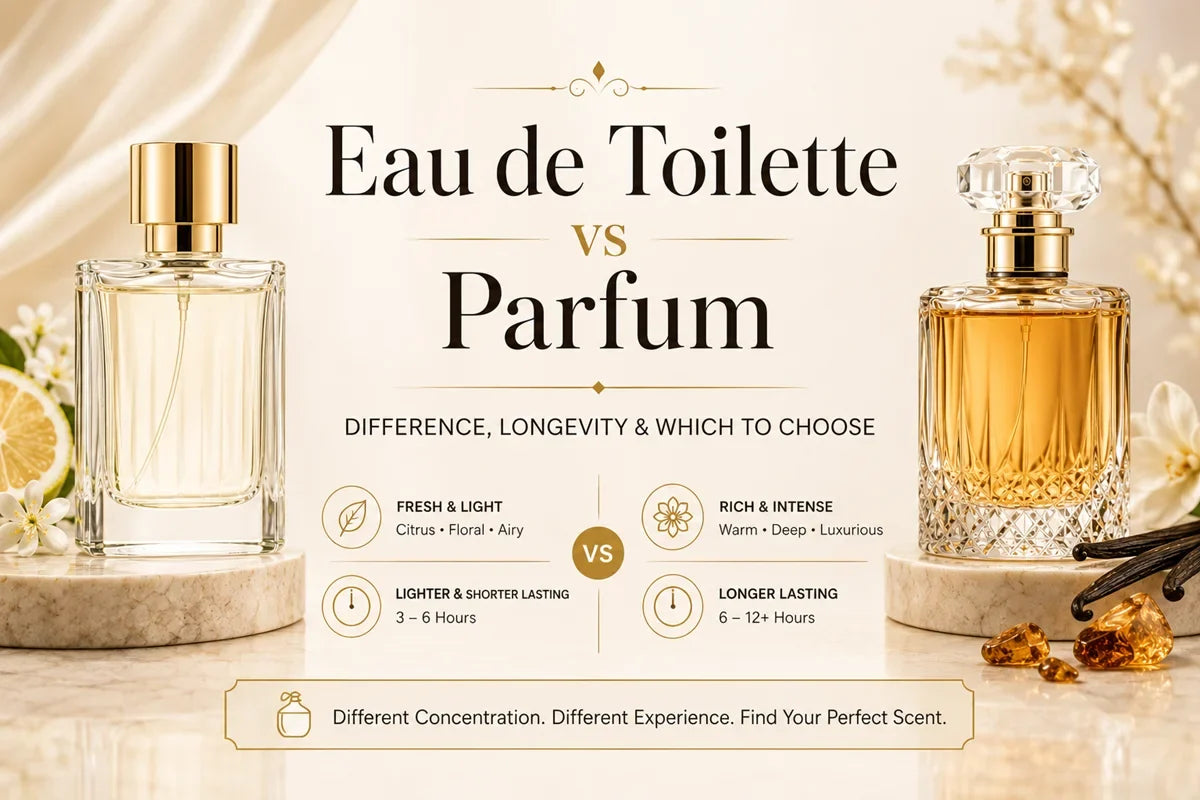
The words Eau de Toilette, Eau de Parfum and Parfum mainly describe different fragrance concentration styles. They can influence how rich a fragrance feels, how long it stays noticeable, how it projects and, often, how much it costs.
But stronger is not automatically better.
The right concentration depends on when you plan to wear the fragrance, how noticeable you want it to be, your climate and your personal taste.
Quick Answer: Eau de Toilette vs Eau de Parfum vs Parfum
| Type | Typical Concentration* | General Character | Often Best For |
|---|---|---|---|
| Eau de Toilette | About 5–15% | Lighter, fresher | Daily wear, warm weather |
| Eau de Parfum | About 15–20% | Richer, fuller | Versatile day-to-evening wear |
| Parfum / Extrait | Often 20%+ | Deep, concentrated | Longer wear, special occasions |
*Concentration ranges are approximate. Brands and formulas vary, and concentration alone does not determine performance.
What Is Eau de Toilette?
Eau de Toilette, usually shortened to EDT, is generally lighter than Eau de Parfum and Parfum.
EDTs often work particularly well for people who prefer:
-
fresher fragrances
-
everyday wear
-
office-friendly scents
-
warm-weather fragrances
-
lighter projection
-
easy reapplication
A fragrance does not become low quality simply because it is an Eau de Toilette.
Some perfumes are intentionally designed as EDTs because a lighter concentration suits the scent's character.
For example, a fresh citrus or aromatic fragrance may feel more natural and comfortable in an EDT concentration.
What Is Eau de Parfum?
Eau de Parfum, or EDP, generally contains a higher concentration of fragrance materials than Eau de Toilette.
That often gives it more depth and longer wear, although the formula still matters.
EDP can be a good choice when you want:
-
a fragrance that transitions from day to evening
-
more noticeable heart and base notes
-
stronger performance than a typical EDT
-
a versatile signature scent
-
a fragrance suitable for gifting
Many designer women's fragrances are offered as Eau de Parfum because this concentration can provide a useful balance between presence and wearability.
What Is Parfum or Extrait de Parfum?
Parfum, sometimes called Extrait de Parfum, is generally one of the most concentrated traditional fragrance formats.
It often feels richer and develops more slowly.
One important point: Parfum does not always mean louder.
A highly concentrated fragrance may stay relatively close to the skin while remaining detectable for a long time.
That makes Parfum especially appealing to people who prefer depth and longevity over a very large scent cloud.
Eau de Toilette vs Eau de Parfum vs Parfum
Here is the practical difference:
Choose Eau de Toilette if:
You enjoy light, fresh fragrance and don't mind refreshing it later.
Choose Eau de Parfum if:
You want a balance between noticeable scent, versatility and longer performance.
Choose Parfum if:
You prefer richer fragrance, slower development and a more concentrated scent experience.
Which Lasts Longer: EDT, EDP or Parfum?
In general:
Parfum → Eau de Parfum → Eau de Toilette
is the usual concentration order.
But real-world performance is more complicated.
A woody Eau de Toilette may outlast a very fresh Eau de Parfum. A heavy amber fragrance can behave very differently from a citrus fragrance even when both have the same concentration label.
Other factors include:
-
ingredients
-
skin type
-
temperature
-
humidity
-
fragrance structure
-
how the scent is formulated
So treat concentration as a useful guide, not a performance guarantee.
For a detailed discussion of actual wear time, see How Long Does Perfume Last?.
Does EDT Smell Different From the EDP Version?
Sometimes, yes.
When a brand offers both an EDT and EDP under the same fragrance name, the formulas may not simply be different strengths of exactly the same liquid.
The brand may change:
-
top notes
-
sweetness
-
freshness
-
base notes
-
balance between ingredients
-
overall character
That means you should not assume you will automatically prefer the EDP just because you enjoy the EDT.
Treat each version as its own fragrance experience.
Which Is Better for Everyday Wear?
For many people, both EDT and EDP can work for everyday use.
Choose EDT when you want something:
-
light
-
fresh
-
casual
-
easy in warm weather
Choose EDP when you want:
-
better staying power
-
a more noticeable signature scent
-
fewer touch-ups
Neither option is universally better.
Which Is Better for the Office?
A moderate Eau de Toilette or softer Eau de Parfum can work well.
The important factor is not only concentration—it is also projection.
A subtle EDP may be more office-friendly than an aggressive EDT.
In shared spaces, apply fragrance with consideration for the people around you.
Which Is Better for Summer?
Many people prefer lighter concentrations during hot weather.
EDTs built around:
-
citrus
-
aquatic notes
-
herbs
-
fresh woods
-
clean musks
can feel comfortable in summer.
That does not mean you cannot wear Eau de Parfum. A fresh EDP can work perfectly well when applied lightly.
Which Is Better for Winter?
Cold weather often suits richer fragrance profiles.
EDP and Parfum fragrances built around:
-
vanilla
-
amber
-
woods
-
spices
-
musk
-
oud
can feel especially comfortable in cooler temperatures.
Which Is Better for a Gift?
If you know the exact fragrance the recipient wants, buy that concentration.
If you're choosing without knowing their preference, Eau de Parfum is often a versatile option because it tends to offer a balance between richness and wearability.
However, fragrance is personal. Concentration does not guarantee someone will like the scent.
Why Is Parfum Usually More Expensive?
Parfum often contains a higher proportion of fragrance materials, which can contribute to a higher retail price.
Pricing can also reflect:
-
brand positioning
-
packaging
-
ingredients
-
bottle design
-
distribution
-
product exclusivity
Higher concentration does not automatically mean better value.
An EDT you wear three times a week can be a much better purchase than an expensive Parfum you rarely enjoy.
Projection vs Longevity
These are not the same thing.
Longevity is how long a fragrance remains detectable.
Projection is how far the fragrance radiates.
Sillage is the trail it leaves behind.
A Parfum can have excellent longevity while staying relatively close to your body.
An EDT may project strongly at first and then fade faster.
How Do You Make Eau de Toilette Last Longer?
Rather than repeating a full application guide here, use the techniques in our dedicated article:
How to Make Perfume Last Longer: Skin, Clothes & All-Day Tips
It covers moisturizing, pulse points, clothing, reapplication and common application mistakes.
FAQs
Is Eau de Toilette stronger than Parfum?
Usually no. Parfum is generally more concentrated.
Is Eau de Parfum the same as Parfum?
No. Eau de Parfum is usually less concentrated than Parfum or Extrait de Parfum.
Which lasts longer, EDT or EDP?
EDP often lasts longer, but formula and fragrance notes can sometimes matter as much as concentration.
Is EDT only for daytime?
No. You can wear an EDT whenever you enjoy it. The labels describe concentration style, not a rule about when the fragrance must be worn.
Is Parfum always the best choice?
No. Some people prefer the freshness and lighter character of EDT. Others prefer EDP or Parfum. The best choice depends on your taste and how you plan to wear it.
Why is Eau de Toilette usually cheaper?
It often uses a lower fragrance concentration, but brand, ingredients and packaging also affect price.
Final Choice
If you want something fresh and easy to wear, start with Eau de Toilette.
If you want a versatile balance of strength and longevity, Eau de Parfum is often a good choice.
If you prefer a richer, more concentrated scent experience, consider Parfum or Extrait de Parfum.
You can explore women's fragrances at Lasting Perfume and compare fragrance styles before choosing.